
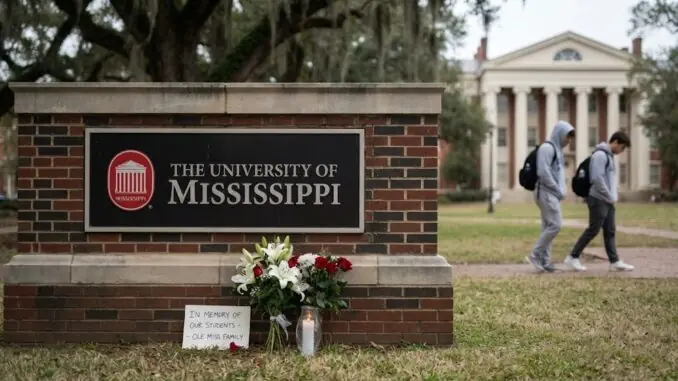
Two Ole Miss students died this week. Packaged kratom was found at both scenes. Here’s what we know—and what the larger numbers show about risk.
The University of Mississippi community is grieving. On Monday, September 21, 2026, two students—an 18-year-old man and a 20-year-old man—were found dead in separate locations.
One was discovered in a campus dorm (Stewart Hall, after a possible overdose call around 1:30 p.m.). The other was found off campus in Oxford.
Lafayette County Metro Narcotics is treating the cases as two separate death investigations. Officials say they have no confirmed evidence the deaths are connected.
Packaged kratom sold from a retail store was recovered at both sites. Critically, investigators have not confirmed that kratom—or any other substance—contributed to either death. Autopsies and toxicology results are expected in two to three weeks.
University leaders expressed heartbreak and urged the community not to speculate on social media rumors of additional deaths. Free Narcan is available on campus and in downtown Oxford parking garages.
This is the human reality behind the headlines: two young lives cut short, families and friends left searching for answers, and a campus left unsettled while tests run their course.
What Is Kratom, and Why Is It Suddenly in the Spotlight?
Kratom comes from the leaves of a tropical tree (Mitragyna speciosa) native to Southeast Asia. People have used it for generations there—sometimes as a mild stimulant for long workdays, sometimes for pain or to ease opioid withdrawal. In the U.S., it is sold in gas stations, smoke shops, and online as powders, capsules, teas, or concentrated extracts.
At lower doses it can feel energizing. At higher doses it produces opioid-like effects: calm, pain relief, sedation.
That dual nature is exactly why it draws both interest and concern. The FDA has not approved it for any medical use and has warned against it. Products vary wildly in strength and purity because federal regulation is limited.
Poison center reports involving kratom rose more than 1,200% between 2015 and 2025, reaching a record 3,434 calls in 2025.
Most exposures involved young adults, especially men. Serious outcomes and hospitalizations climbed too.
Of the 233 kratom-associated deaths tracked in that period, about 79% involved other substances—often opioids, benzodiazepines, stimulants, or alcohol. Pure kratom deaths are rare, but they do occur.
In Mississippi, kratom is legal at the state level under recent regulations (age 21+, certain potency limits, retailer rules).
Many cities and counties, however, have local bans. Oxford and Lafayette County are among the places with restrictions, which adds another layer of complexity to the current investigations.
How Many People Die From Kratom?
There is no single clean national “kratom death” total that matches the scale of fentanyl or meth. The best available data come from poison centers and medical examiner reports.
Over roughly a decade, a few hundred deaths have been linked to kratom in some way—most involving multiple drugs.
In individual states and counties, coroners occasionally list mitragynine (the main alkaloid) as a contributing or sole factor, but these remain a small fraction of overall overdose deaths.
That does not mean the risk is zero. Concentrated products, contaminated batches, or mixing with other substances can turn a substance marketed as “natural” into something dangerous.
The Ole Miss cases underscore why officials issued a caution even before toxicology results: presence at a death scene is a red flag worth heeding while facts are still emerging.
What Drug Has the Highest Death Rate?
Fentanyl and other illegally manufactured synthetic opioids. By a wide margin.
In recent years fentanyl has been involved in the large majority of U.S. drug overdose deaths. CDC data consistently rank it first, followed by methamphetamine and cocaine.
Provisional figures show overall drug overdose death rates declining from the 2022 peak (around 32–33 per 100,000) into the mid-20s and lower in some 2024–2025 estimates, but synthetic opioids still drive the bulk of the toll.
Kratom sits far down the list. It is not in the same category of lethality.
What Are the Odds of Dying From an Overdose?
Lifetime odds help put the numbers in perspective. According to National Safety Council estimates based on 2024 data:
- Accidental opioid overdose: roughly 1 in 84
- All preventable injuries: about 1 in 22
- Motor-vehicle crash: about 1 in 101
Overall drug overdose risk is higher than the opioid-only figure because it includes stimulants and mixed-drug deaths.
At the peak rates seen a few years ago, some analyses put lifetime overdose risk closer to 1 in 40. Rates have since fallen, so current lifetime odds are somewhat better—but still far higher than many people realize.
These are population averages. Individual risk depends heavily on the specific substances used, whether they are mixed, dose, purity, tolerance, and access to naloxone and emergency care.
Looking Beyond the Headlines
The two Ole Miss deaths are still under investigation. Until toxicology is complete, no one can say with certainty what caused them.
The recovery of packaged kratom at both scenes prompted a public health-style warning: avoid unregulated substances, stick to prescribed medications from trusted sources, and know where Narcan is available.
For students, parents, and anyone navigating a culture of easy-access “herbal” products, the larger lesson is straightforward.
Substances sold next to energy drinks and snacks can still carry real risk—especially when potency is inconsistent or other drugs are involved. The deadliest threat by volume remains fentanyl-laced supplies.
The quieter but rising concern is the growing use of less-regulated alternatives whose long-term safety profile is still being written in real time by emergency rooms and coroners’ offices.
Two families in Mississippi are living the cost of that uncertainty right now. The rest of us can honor them by waiting for the facts—and by treating every unregulated substance with the caution the data demand.
Sources
- Mississippi Today, Fox News, USA Today / Clarion Ledger, CNN, People, Newsweek, NBC News, Action News 5 reporting on the Ole Miss deaths (September 22–23, 2026)
- Lafayette County Metro Narcotics statements and University of Mississippi communications
- CDC / National Poison Data System analyses of kratom exposures 2015–2025
- National Institute on Drug Abuse and FDA materials on kratom
- CDC National Vital Statistics System and NCHS reports on drug overdose deaths 2017–2025
- National Safety Council “Odds of Dying” data (2024)
- Mississippi state and local kratom regulations (HB 1077 and municipal ordinances)


Leave a Reply