
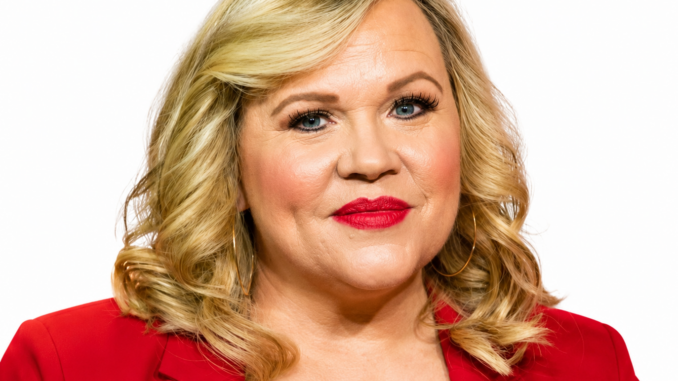
Holly Rowe: The Passionate Voice Behind the Sidelines Who Turned Tears Into Triumph
Holly Rowe has spent decades bringing the human side of sports to millions of viewers.
As one of ESPN’s most versatile and longest-tenured reporters, she covers everything from college football under the lights to the WNBA’s biggest moments.
Fans know her for sharp questions, genuine enthusiasm, and the way she makes athletes feel seen.
What many may not realize is how her own story—of grit, single motherhood, a life-threatening illness, and pure love for the games—mirrors the resilience she highlights in others.
From Utah Roots to the Big Stage
Born June 16, 1966, in Woods Cross, Utah, Rowe grew up a self-described “geeky tomboy” obsessed with sports.
She played softball, basketball, volleyball, and track in high school but never got the chance to compete at the college level as Title IX was still finding its footing. That early frustration later fueled her advocacy.
After Woods Cross High School, she spent time at Brigham Young University before transferring to the University of Utah.
There she earned a journalism degree in 1991, wrote for the Daily Utah Chronicle, and anchored campus news.
She interned widely, including at CBS Sports, and created her own opportunities—buying radio airtime to broadcast University of Utah women’s basketball games for the first time.
She joined ESPN full-time in 1998 after earlier freelance work with ABC and the network. Over more than 25 years she has become a fixture on Saturday Night Football, the NCAA Women’s Final Four, Women’s College World Series, volleyball championships, and the WNBA.
In 2021 she made history as the Utah Jazz’s first female color commentator. Awards followed: a 2022 Sports Emmy for Outstanding Personality/Reporter, the Mel Greenberg National Media Award, the Curt Gowdy Electronic Media Award from the Naismith Memorial Basketball Hall of Fame, and induction into the Utah Sports Hall of Fame in 2025.
She is famous for treating every assignment—whether a Division III title game or a national championship—as the biggest of the night, and for telling the personal stories that stats alone cannot capture.
Family First: Raising McKylin as a Single Mom
Rowe has kept much of her private life private. She is not married and has spoken openly about raising her son, McKylin Jordan Rowe (born in 1995), as a single mother. She named him after her favorite athlete, Michael Jordan.
McKylin works in entertainment as an actor, writer, and producer, with credits including American Underdog.
Mother and son share a close bond; they have co-hosted a podcast and leaned on each other through hard times. Rowe has described their relationship simply: “It’s just been the two of us. We’re very, very close.”
Height reports place her around 5 feet 5 inches. Net-worth estimates float near $3 million, with annual earnings from ESPN often cited around $800,000—figures typical of long-tenured network talent but never officially confirmed by Rowe herself.
The Fight of Her Life: Cancer and Comeback
In 2015 Rowe noticed a spot on her chest. What began as a seemingly minor issue was diagnosed as desmoplastic melanoma, a rare and aggressive form of skin cancer.
It spread to her lymph nodes and then her lungs, becoming Stage IV metastatic melanoma.
Doctors performed multiple surgeries. She continued working through treatment, sometimes with drainage tubes under her clothing and a wig on the sidelines.
A UCLA clinical trial involving the immunotherapy drug Keytruda (pembrolizumab) ultimately shrank her tumors dramatically.
She has called herself “literally a miracle,” noting the low odds the treatment would work. Regular scans continue, and she remains an outspoken advocate for cancer research, prevention, and living with intention.
Through a nonprofit effort she has helped fund scholarships for young athletes facing their own health battles. The experience deepened her appreciation for joy in everyday moments and strengthened her determination to keep covering the sports she loves.
Tears, Crowds, and the Caitlin Clark Moment
Rowe’s passion for women’s basketball runs especially deep. She has covered Caitlin Clark’s rise closely and celebrated the explosion of interest in the WNBA.
In August 2026, before an Indiana Fever–Toronto Tempo game at Scotiabank Arena, Rowe filmed herself overcome with emotion. Nearly 19,000 fans filled the stands for a women’s basketball game in Canada.
“I’m trying to work a basketball game tonight,” she said through tears, “but I keep crying because look at what they have built… I’m just so proud.”
The video went viral. Some viewers praised her lifelong advocacy for the women’s game. Others criticized her for not specifically naming Caitlin Clark as the driving force behind the turnout.
The moment captured both the progress Rowe has spent decades championing and the intense scrutiny that comes with covering a sport in the national spotlight.
Why Her Story Still Resonates
Holly Rowe never set out to be the story. She simply refused to wait for permission—creating radio broadcasts when none existed, volunteering for sideline roles that weren’t offered, and showing up for work even while fighting cancer.
She brings the same energy to every interview and the same honesty when talking about her son, her health, or the growth of women’s sports. In an industry that often prioritizes flash, her steady presence and genuine care stand out.
Whether she is on the football sideline, courtside at a Final Four, or sharing a quiet moment of pride at a sold-out WNBA arena, Rowe reminds viewers that sports are about people—their struggles, their triumphs, and the joy of simply being there.
Sources
- ESPN Press Room bio
- Wikipedia (Holly Rowe)
- Deseret News profiles and interviews
- UCLA Health / Cancer Today magazine features
- University of Utah commencement coverage
- Contemporary reporting on the August 2026 WNBA emotional video (OutKick, New York Post, Hindustan Times, and related outlets)
- Guideposts and other first-person accounts of her cancer journey


Leave a Reply