
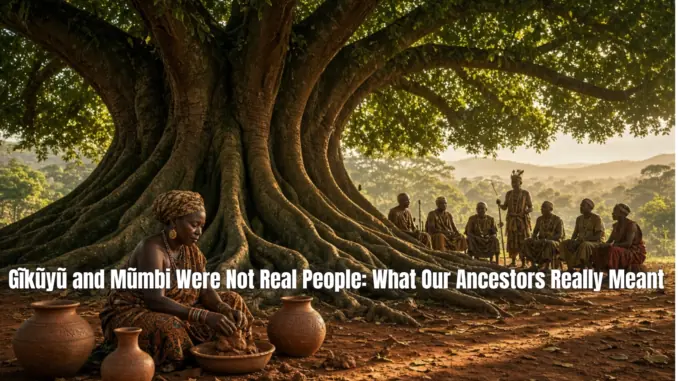
Gĩkũyũ and Mũmbi: The Deeper Meaning of Agĩkũyũ Heritage
We are suffering from a dangerous collective amnesia, and our young people are paying a very high price for it.
Because we have swallowed a shallow, Westernized, and hyper-literal way of reading our own history, a massive identity crisis is rotting our heritage from the inside out.
Today, young people look at the foundational pillars of our people and genuinely believe that Gĩkũyũ and Mũmbi were two literal, biological human beings of flesh and bone who magically popped into existence a few centuries ago, wandering an empty continent alone.
When our youth try to defend this literal, cartoonish version of our history against modern science and critical thought, they are rightfully met with doubt and criticism. This leaves them confused, defensive, and, in the end, disconnected from their ancestral roots..
But let us be painfully honest with ourselves: the failure does not lie with our ancestors; it lies with us. We have taken a very intelligent and highly developed social system and reduced it to what looks like a simple bedtime story.
It is time to stop embarrassing and weakening our heritage by reading everything literally. The story of Gĩkũyũ and Mũmbi was never meant to be a basic science lesson about human biology or a simple family history.
Instead, it is a deep lesson in nation-building, a strong legal system, and a detailed social plan created to help a society live together without tyrants, prisons, or permanent armies.
If we want our youth to respect their history, we must first stop insulting their intelligence by teaching it backwards. It is time to look deeper and understand the hidden ideas.
We can see that the story of Gĩkũyũ and Mũmbi is not a science textbook about human biology. Instead, it is a highly developed social constitution and a masterclass in how to build a peaceful and organized nation.
Our ancestors were deep thinkers. They used strong images, symbols, and stories to pass laws, values, traditions, and systems of government from one generation to another.
Below is a detailed look at the deeper codes hidden within this incredible heritage, and what they really mean for us today.
Here is a breakdown of the deeper structure behind the names, their philosophical meanings, and the cultural systems they represent:
1️⃣ The Meaning of Gĩkũyũ
When we look at the name Gĩkũyũ, it is easy to think of it simply as the name of a person. But in traditional Agĩkũyũ thinking, names have deep meaning. They can carry history, ideas, values, and philosophy.
The Root of the Name
If we look closely at the word Gĩkũyũ, it is naturally connected to Mũkuyu, the wild fig tree, also known as the Sycamore Fig. In our communities, this tree is commonly known as the Mukuyu tree.
Our ancestors did not make this connection by accident. They chose it because the fig tree is one of the most important and useful trees in the environment. They used it as a living picture of how a community should grow, remain strong, and live together.
The Botanical Distinction: Mũkuyu vs. Mũgumo
To truly understand how our ancestors thought, we must first look at the actual trees they lived with and respected in the rich lands of Central Kenya.
In the traditional Agĩkũyũ environment, two closely related fig trees had great symbolic importance. Our ancestors did not choose these trees randomly.
They chose them because their natural qualities closely reflected ideas about human society, leadership, government, and philosophy.
-
Mũkuyu (Ficus sycomorus / The Sycamore Fig):
This is the large tree traditionally connected to the name Gĩkũyũ. The Mũkuyu is known for its very wide and strong trunk, its large root system that holds firmly to the ground, and its sweet, heavy fruits that grow in clusters along its trunk and branches. In our traditional understanding, it represents physical nourishment, strength, stability, and the ability to provide for the community. It is a tree that stands strong, solid, and dependable through different seasons.
-
Mũgumo (Ficus thonningii or Ficus natalensis / The Strangler or Natal Fig):
This is the famous and deeply sacred tree of the Agĩkũyũ. The Mũgumo can begin from a tiny seed dropped by a bird high in the branches of another tree. As it grows, it can spread around and eventually cover its host tree. It can then form a huge canopy that provides cool shade over the ground. It is traditionally seen as an important sacred place connected to ancestral spirits and as a meeting point between human beings and the divine (Ngai).
How Gĩkũyũ Got His Name from the Mũkuyu
When people ask, “How did Gĩkũyũ actually get his name from the Mũkuyu tree?” they may imagine a man walking up to a tree and simply deciding to take its name. But traditional indigenous naming was not that simple. It involved language, symbolism, and deep philosophical ideas.
-
The Linguistic Bridge:
In the Agĩkũyũ language, changing the prefix of a noun can change its size, importance, and meaning. Mũkuyu is the normal, singular name for the sycamore fig tree. When our ancestors wanted to describe the greater idea behind the tree, including its large size, strength, shelter, and protective qualities, they connected it to Gĩkũyũ as a larger and more powerful form of the idea.
-
The Philosophical Transfer:
The ancestor was not simply named after a tree. Instead, the community connected the founding idea of the nation to the tree. Why? Because the Mũkuyu represented many of the things a community needed in order to survive and grow:
- Its wide and strong trunk was a powerful symbol of strong protection.
- Its deep roots represented law, history, and a strong connection between generations.
- Its wide and welcoming shade could become a meeting place where the Kĩama (council of elders) gathered to make decisions, settle land disagreements, and maintain peace.
Therefore, calling the founding father “Gĩkũyũ” was a powerful poetic way of saying: Our founding father is the Great Tree—the strong institutional shelter and legal roof under which we all find law, peace, and protection.
How the Trees “Marry” in the Story (The Ecological Union)
In nature, the Mũkuyu and the Mũgumo belong to the same botanical family, Moraceae, which is the fig family. They can also grow in the same East African environment, sharing soil, rain, and the wider ecosystem.
When the traditional oral story says that Gĩkũyũ met Mũmbi at Mukurwe wa Nyagathanga beneath a fig tree, the ancestors were expressing a deeper idea through nature and society.
- Gĩkũyũ (The Mũkuyu / Structure & Law): This represents the physical structure of society, legal boundaries, protection of the community, and the public meeting place. These ideas can be compared with the strong trunk and protective shade of the tree.
- Mũmbi (The Potter / Mũgumo-Related Life & Nurture): This represents the shaping of society, social unity, emotional understanding, and the passing of culture from one generation to another. This can be compared with soft clay being carefully shaped into a useful vessel under the protection of the tree’s shade.
The “marriage” is a powerful metaphor for bringing structure and design together. A society cannot survive through laws and physical protection alone. It needs people, relationships, care, education, and a strong social bond. In the same way, a society cannot survive through care and community support alone if it has no boundaries, laws, or systems of protection.
By “marrying” Gĩkũyũ and Mũmbi beneath the sacred canopy, our ancestors were teaching an important and lasting lesson: a stable and peaceful nation can grow only when strong protection and law (Gĩkũyũ) come together with social creation, education, and human care (Mũmbi) to build a strong and lasting home for the community.
The Ecological and Spiritual Metaphor
In traditional Agĩkũyũ thinking, the Mugumo tree was seen as an important meeting point between God (Ngai) and human beings. Think about what a mature Mugumo tree looks like and how it acts in nature:
-
Its Roots: It has massive, incredibly strong roots that dig deep into the earth. This deep root system represents generational grounding. It teaches us that a strong society must be deeply rooted in its values, history, and land so it cannot be easily blown away by the winds of change.
-
Its Canopy: It has a wide, thick, spreading umbrella of leaves and branches. This canopy provides deep, cool shade. In a hot and difficult land, it offers literal shelter to tired travelers, animals, and children.
Metaphorically, this canopy represents spiritual and physical protection. Just as the tree protects people from the harsh sun and rain, our foundational systems protect us from chaos and confusion.
Sociopolitical Application: The Great Institutional Roof
By framing the foundational ancestor as “Gĩkũyũ,” our wise ancestors were not trying to tell us about a single man made of flesh and bone who walked alone. Instead, they were pointing us to an institutional framework of shelter, protection, and law.
In the old days, when the community needed to solve a serious problem, settle a dispute, make a major law, or offer prayers, they did not go inside a concrete building. They gathered underneath the massive, wide shade of the Mugumo tree.
Therefore, when we say “Gĩkũyũ,” we are talking about the structural canopy under which the entire society finds its security, unity, and continuity. It is a brilliant way of saying: Our community is a protected house, built on strong roots and laws, where everyone can find shelter, justice, and peace.
2️⃣ The Meaning of Mũmbi
To truly understand why our ancestors gave the foundational mother of our nation the name Mũmbi, we need to look closely at the Agĩkũyũ language and at how traditional societies understood creation.
We cannot just treat Mũmbi as an ordinary woman who gave birth to children; we have to look at the deep philosophy of design, building, and social shaping that her name carries.
The Root of the Name and the Work of the Potter
In the Agĩkũyũ language, the name Mũmbi comes directly from the verb kũũmũba. This verb means to mold, to shape, to design, or to form something. It can be compared to the work of a traditional potter who takes soft, shapeless clay from the riverbank and carefully turns it into a useful pot, water jar, or cooking vessel..
Think about what a potter does. Clay by itself is simply earth. It has no useful shape, no clear purpose, and cannot hold water. But in the hands of a skilled potter, the raw clay is pressed, shaped, smoothed, and fired until it becomes something useful and beautiful for everyday life.
By giving the founding mother the name “Mũmbi,” our ancestors were using this powerful picture. They were showing that society does not simply appear by accident. It has to be carefully shaped, organized, and developed with patience, knowledge, and skill.
The Philosophy of Nurture and Continuity
While the fig tree (Gĩkũyũ) represents the strong structure, the shelter, and the fixed legal roof of the community, Mũmbi represents the active, living force that brings that structure to life.
-
The Nurturing Force: A house can be built under the shade of a tree, but without someone to care for the home, cook the food, raise the children, and pass down values, the house will fall apart. Mũmbi represents the feminine principle of care, emotional intelligence, patience, and nurture.
-
The Social Fabric: Society is made up of human relationships. It requires constant care, conflict resolution, empathy, and teaching to keep people bound together. Mũmbi is the philosophy that holds this social fabric together. She is the internal glue of the community.
-
Generational Continuity: A nation dies if it cannot pass its knowledge to the next generation. Mũmbi represents the continuous cycle of birth, growth, teaching, and cultural preservation. She is the creative spark that ensures the community does not just survive for a single season, but continues to thrive across hundreds of years.
Sociopolitical Application: Honoring the Architects of Society
When our elders taught us about Mũmbi, they were celebrating the essential role of women not just as mothers in a biological sense, but as the original builders (architects) and designers of human culture.
In ancient Agĩkũyũ governance, the community recognized that while laws and structures (the tree) are important, the heartbeat of a nation comes from the values, social order, and human care that shape its citizens (the potter’s work).
By understanding Mũmbi this way, the youth stop seeing a simple myth and instead see a deep, respectful acknowledgment of the feminine power that built the very foundation of our civilization.
3️⃣ The Nine Daughters and the Clan System
When we read the story of the daughters of Gĩkũyũ and Mũmbi in a completely literal way, we immediately face questions that many young people struggle to answer: How could only nine or ten sisters populate an entire nation? How did these daughters get married, and who did they marry if Gĩkũyũ and Mũmbi were the only human beings?
When we shift from biology to sociology, the answers become clear. The daughters were never meant to be read as isolated individuals sitting in a homestead. Instead, they represented large political and legal institutions.
They served as the constitutional foundations of the Mĩhĩrĩga (the clan system), a highly organized system created to manage a growing society without the need for one central king, a permanent army, or a forceful police system.
The True Identity of the Nine Names: Constitutional Designations
In ancient indigenous governance, naming was a legal act. The names traditionally associated with the daughters (Wanjrũ, Wambũi, Wanjikũ, Njeri, Nyambũra, Wairimũ, Wangũi, Wangeci, and Mũthoni) were not merely personal identifiers given at birth.
They were foundational charter names for sociopolitical units. When a community grew too large to manage under a single local council, it divided and organized itself along these specific maternal lineages.
Each name represented a different branch of society, with its own internal responsibilities, areas of authority, and territorial relationships.
1. Decentralization of Power and Preventing Autocracy
One of the greatest achievements of the Agĩkũyũ clan system was its absolute rejection of centralized tyranny.
-
Distributed Authority: By organizing the clans (Mĩhĩrĩga) around different foundational lineages, political power was spread out. No single family or individual could easily take control of the whole society and declare themselves an absolute ruler because authority was shared among the major maternal branches.
-
Checks and Balances: Governance was carried out through a number of councils (Kĩama) where representatives from different lineages had to discuss issues, consider different views, and work toward agreement. The “daughters” therefore represented a system of shared government long before modern political science developed similar ideas.
2. The Exogamy Law: The Ultimate Safeguard Against Inbreeding
From a biological point of view, a very small founding population would face serious genetic problems after several generations if people were allowed to marry freely within the same family group.
The clan system addressed this through a strict rule known as exogamy, which means marrying outside one’s own clan.
-
The Rule of Blood and Lineage: The system required that a person could not marry someone from their own mother’s clan.
-
Binding the Nation Together: This rule turned the different lineages into a connected and interdependent network. Because people had to find marriage partners outside their own lineage, every marriage created a peaceful and legally recognized relationship between different clans. This helped reduce conflict and isolation because communities became connected through marriage.
3. Regulating Resource Sharing and Land Stewardship
A growing nation needs clear rules for sharing land, water, grazing areas, and farming fields. Without such rules, competition over resources can create serious conflict.
-
Equitable Distribution: The clan system helped organize land use and the sharing of resources. Land rights, farming areas, and grazing arrangements could be managed through these lineage structures.
-
Stewardship Over Ownership: Land was viewed not as a commodity to be hoarded by individuals, but as a sacred trust held on behalf of past, present, and future generations. The lineage system ensured that every clan member had access to the means of survival, preventing extreme wealth concentration and poverty.
4. Mutual Aid Networks (Ngwatio and Social Security)
In a traditional society, there were no commercial banks, insurance companies, or government welfare programs. The clan served as an important social safety net.
-
Built-In Solidarity: The lineage structures connected to the foundational names helped ensure that individuals did not have to face serious problems alone. If a family’s crops failed, a home was destroyed by fire, or an elderly person became sick, the wider clan could provide help through shared work and mutual support systems such as ngwatio.
-
The Social Contract: Every person understood where they belonged, what responsibilities they had toward their relatives, and what kind of support and protection they could expect from the community in return.
Summary: The Masterclass in Nation-Building
When our elders tell the story of the daughters of Gĩkũyũ and Mũmbi, they are passing down a lesson in indigenous constitutional law.
They were not simply describing a family tree. They were explaining how a free, organized, and peaceful society could build systems that helped it survive.
By looking more deeply at these names, our young people can see their ancestors as highly skilled political thinkers, legal minds, and builders of a civilization that could last for generations.
Why This Perspective Matters
Looking at these foundational stories through a social and philosophical lens changes the discussion.
Instead of focusing only on a literal argument about biology, we can also appreciate the advanced ideas about indigenous law, government, social organization, and respect for the natural environment.
This way of understanding the stories presents ancestral heritage not as a weak or simple myth, but as a lasting guide for community organization, identity, and social life.
Conclusion: The Journey Continues
When we remove the layers of literal misunderstanding, we can begin to see more clearly what our ancestors were trying to communicate. They were not simply primitive storytellers. They were deep thinkers who understood society, law, government, and human relationships and used stories and symbols to preserve that knowledge.
Yet, we have only started opening the door. What about the deeper source of our spiritual understanding? What was Ngai truly understood to mean before foreign religious ideas changed the way we looked at our traditions? And what knowledge is connected to the sacred grounds of Mukurwe wa Nyagathanga?
In our next deep dive, we will look more closely at these ideas, question some of the modern interpretations that have shaped our understanding, and explore the spiritual structure connected to Ngai and the deeper meaning of Mukurwe wa Nyagathanga. Stay tuned.
Sources & Academic Foundations
- Jomo Kenyatta – Facing Mount Kenya (1938): Examines traditional Agĩkũyũ society, the Kĩama council, land systems, and sacred trees such as Mũgumo and Mũkuyu.
- Godfrey Muriuki – A History of the Agikuyu, 1500–1900 (1974): Explores Agĩkũyũ migration, clans (Mĩhĩrĩga), political organization, and territorial systems.
- L.S.B. Leakey – The Southern Kikuyu Before 1903 (1977): Provides detailed research on Agĩkũyũ customs, law, spirituality, clans, and traditional social organization.
- Mwangi wa JamAFRIKA and contemporary Kenyan cultural thinkers: Offer modern and decolonial perspectives on African traditions and alternative interpretations of indigenous stories.


Leave a Reply