
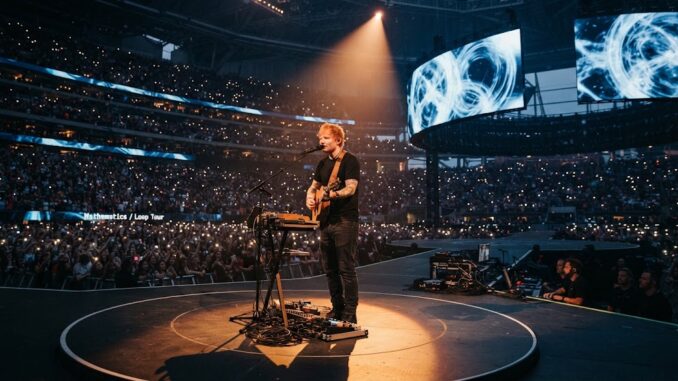
Ed Sheeran’s Loop Tour: Inside the Record-Breaking Run That Turned Political Lightning Rod
Ed Sheeran has spent fifteen years turning a loop pedal and a battered acoustic guitar into one of the biggest live shows on Earth.
In 2026, that formula collided with something no setlist could smooth over: a geopolitical controversy that cost him four supporting acts in a single week.
This is the story of the Loop Tour — the music, the money, and the moment it stopped being just a concert.
From Suffolk Pub Gigs to Stadium Physics
Sheeran’s rise still reads like a fluke, even now. A red-haired teenager from Suffolk, England, sofa-surfed around London for years, playing open mics and burning his own CDs by hand.
He caught a break in 2011 when Jamie Foxx spotted him and introduced him to producer will.i.am, which led to a deal with Atlantic Records.
What happened next wasn’t a fluke at all. It was engineering.
Sheeran figured out how to fill a football stadium with just himself, a guitar, and a loop station — recording his own harmonies and beats live, layer by layer, until one man sounded like a full band.
That stripped-down spectacle became his signature, and it printed money.
His Divide Tour grossed $775.6 million. His follow-up, the Mathematics Tour, topped that at $875.7 million, making the two of them among the highest-grossing tours in music history.
By 2026, Celebrity Net Worth pegged his fortune at roughly $400 million, built on streaming royalties, songwriting publishing, a guitar company, real estate, and a touring model that reportedly keeps around 60% profit margins — far higher than acts who tour with full bands.
He also closed a 15-year chapter this year, parting ways with Warner Music after a run that generated 170 million album sales and more than 126 billion streams.
None of that fortune, though, could buy him out of what happened next.
The Loop Tour Takes Shape
Named for his eighth studio album, Play, the Loop Tour kicked off January 16, 2026, in Auckland, New Zealand, and was built to be his biggest run yet:
- Oceania leg: 15 shows across Australia and New Zealand, expanded from 11 after overwhelming demand
- Latin America leg: announced in two phases, spring and winter 2026
- North America leg: 26 stadium dates from June 13 (State Farm Stadium, Glendale, AZ) through November 7 (Raymond James Stadium, Tampa), hitting SoFi Stadium, MetLife Stadium, and Toronto’s Rogers Centre along the way
The tour promised an all-new stage design, songs from Play mixed with career-spanning hits, and a rotating cast of openers: Macklemore, Lukas Graham, Finneas, Aaron Rowe, Sigrid, Beoga, and others across different legs and regions.
For months, it looked like just another chapter in Sheeran’s record-breaking streak. Then came the shows in New Jersey.
What Macklemore Did — and What Came After
Macklemore joined the Loop Tour’s North American leg in early September, opening two nights at MetLife Stadium on September 4 and 5.
During the first show, he told the crowd part of the reason he wanted the slot was the chance to say “Free Palestine” from inside a stadium — and he did, along with imagery referencing Israel’s military campaign in Gaza.
The clip spread fast. Singer Pink, who is Jewish, publicly pushed back, saying she wasn’t trying to get anyone fired, but objected to Macklemore telling Jewish fans in the crowd that the moment “wasn’t about them.” Others in the audience and online voiced similar frustration.
By September 14, the tour’s U.S. promoter, Messina Touring Group, announced Macklemore was out. In a statement, the promoter said venues on the remaining dates had warned they wouldn’t host the tour at all if he stayed on the bill.
Macklemore Speaks, Kraft Responds
Macklemore didn’t go quietly. In a lengthy Instagram post, he said Sheeran told him that New England Patriots owner Robert Kraft — who also owns Gillette Stadium, one of the tour’s upcoming venues — had personally intervened.
According to Macklemore, Kraft told Sheeran he wouldn’t allow Macklemore to perform at Gillette, then rallied other stadium owners into a joint ultimatum: drop Macklemore, or lose the venues entirely.
Kraft confirmed he made the call to bar Macklemore from Gillette. In a statement, he pointed to Macklemore’s comments and imagery at the New Jersey shows, plus what Kraft called “a broader history of antisemitic rhetoric and imagery” he found offensive to the Jewish community. Kraft did not directly address the claim that he pressured other venue owners.
What stood out in Macklemore’s statement wasn’t anger — it was perspective. “I am not a victim,” he wrote. “Ed Sheeran is not a victim. Pink is not a victim. We have careers, money, opportunities, safety and audiences around the world.”
He called Sheeran his “brother” and acknowledged the impossible spot the controversy put him in. Then he added a line that’s since been widely quoted: if losing the stage kept the conversation about Palestine going, it was “the most successful tour I’ve ever been on.”
Sheeran Breaks His Silence
Sheeran, known for staying deliberately apolitical, addressed the fallout directly. He said the decision to remove Macklemore belonged to the promoter, not him — Macklemore’s contract was with Messina, not with Sheeran personally.
He also explained why he avoids political statements on stage at all. “There is a reason I do not use my professional platform for politics,” he wrote. “My audience includes young people, often children, of all backgrounds.
Those who come to my shows do not expect a political forum.” He said he respected Macklemore, and that he was personally troubled by the Israel-Palestine conflict — but drew a hard line between his own beliefs and what he’ll say from a stage he built to be a shared, neutral space.
It’s a tension a lot of performers know well: the bigger the platform, the more anything you do with it — or don’t — gets read as a statement.
The Exodus That Followed
Macklemore’s removal didn’t stay contained. Within a day, three more supporting acts pulled out in solidarity:
- Finneas — the Grammy-winning producer and Billie Eilish collaborator — wrote, “Artists must not be silenced when they speak up for the oppressed. I have decided to withdraw from my upcoming tour dates with Ed Sheeran. I stand with Palestine.”
- Lukas Graham, the Danish pop act behind “7 Years,” also withdrew.
- Aaron Rowe and Irish folk group Beoga followed suit.
For a tour built around good-time crowd-pleasers and stadium sing-alongs, it was an unusually raw week — a reminder that even the most carefully neutral artist can get pulled into a fight he never wanted to have.
The Tour Rolls On
Despite the shake-up, the Loop Tour has kept moving. Upcoming U.S. stops include:
- September 19 — Lincoln Financial Field, Philadelphia, PA
- September 25–26 — Gillette Stadium, Foxborough, MA
- October 3 — Mercedes-Benz Stadium, Atlanta, GA
- October 10 — Lucas Oil Stadium, Indianapolis, IN
- October 17 — Bank of America Stadium, Charlotte, NC
The tour is scheduled to wrap in Mexico City in December 2026, having played more than 50 shows across four continents and grossed tens of millions of dollars along the way — even before factoring in the wall-to-wall media coverage the Macklemore controversy generated.
Why This Story Matters Beyond the Headlines
Strip away the celebrity names, and this is a story that’s played out across the entertainment industry for years: what happens when an artist’s convictions collide with the business machinery around them.
Macklemore has never been shy about activism — he’s spoken on LGBTQ+ rights, addiction recovery, and racial justice throughout his career.
This time, though, the backlash wasn’t just online noise. It reached the people who actually own the buildings where music happens, and it moved fast enough to reshape a world tour in a matter of days.
For Sheeran, it’s a lesson in how even carefully guarded neutrality can’t fully insulate an artist from the politics swirling around him — his stages, his brand, and his silence all became part of the story whether he wanted that or not.
The Loop Tour will likely be remembered for its music. But 2026 may also be the year it’s remembered for something else entirely: a reminder that in an era of instant clips and viral outrage, no stage — however big, however apolitical its owner tries to keep it — is fully immune to the world outside it.
Is Ed Sheeran touring in 2026?
Yes. Ed Sheeran is scheduled to continue the LOOP Tour through the United States and Latin America in 2026.
As of September 16, the official tour website lists these upcoming shows:
These listings come from Sheeran’s official website, although the support-act information may change after the recent withdrawals.
Sources
- Rolling Stone — “Macklemore Dropped From Ed Sheeran Tour After Onstage ‘Free Palestine’ Statements”
- Billboard — “Ed Sheeran Tour Drops Macklemore: A Timeline of the Controversy”
- ABC News — “Ed Sheeran speaks out after Macklemore dropped from tour over pro-Palestinian comments”
- The Hollywood Reporter — “Macklemore Responds After Removal From Ed Sheeran Tour”
- NBC News — “Macklemore says he was dropped from Ed Sheeran tour after Patriots owner Robert Kraft organized boycott”
- Wikipedia — “Loop Tour”
- Gillette Stadium — Official Loop Tour event page
- Ford Field — Official Loop Tour event page
- MetLife Stadium — Official Loop Tour event page
- Ticketmaster — Ed Sheeran 2026–2027 Concert Tour Dates
- Celebrity Net Worth — “Ed Sheeran Net Worth”


Leave a Reply