
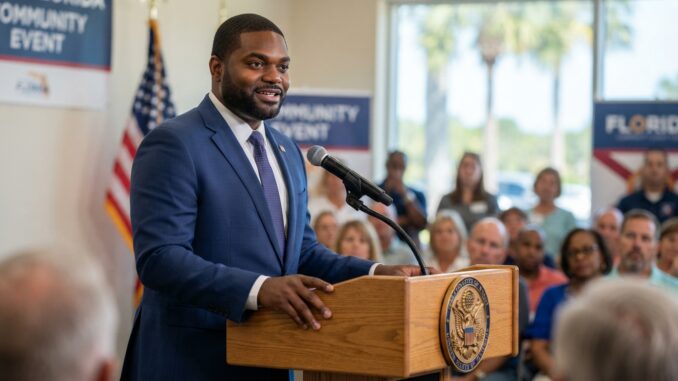
Byron Donalds: From Brooklyn to the Brink of Florida’s Governorship
Byron Donalds just made history. On August 18, 2026, the three-term congressman from Naples won the Republican primary for Florida governor with roughly 48% of the vote, setting up a November showdown against Democrat David Jolly and positioning himself to become Florida’s first elected Black governor.
The Primary Victory That Set the Stage
Donalds didn’t just win—he dominated a crowded field. Facing Lt. Gov. Jay Collins, former House Speaker Paul Renner, and conservative firebrand James Fishback, he leveraged a record-setting $111 million campaign war chest to blanket the state with ads and secure the nomination.
With 97% of votes counted, Donalds captured 48% of the Republican electorate, while Collins trailed at 25%, Fishback at 10.5%, and Renner at 8.5%.
The victory fulfills a trajectory that began when Donald Trump endorsed him early in the race, signaling to the GOP base that Donalds was the heir apparent to term-limited Gov. Ron DeSantis.
Donalds has pledged to implement Trump’s agenda if elected, aligning himself closely with the former president’s vision for Florida and the nation.
On the Democratic side, former U.S. Rep. David Jolly emerged from a five-candidate field to claim the nomination, setting up a general election that will test whether Florida remains a red stronghold or becomes more competitive.
Early Life: Crown Heights to the Sunshine State
Byron Lowell Donalds was born on October 28, 1978, and raised in the Crown Heights neighborhood of Brooklyn, New York.
He and his two sisters were brought up by a single mother in what he has described as a difficult childhood—a backdrop that shaped his drive and resilience.
At 17, Donalds moved to Florida to attend college, first enrolling at Florida A&M University before transferring to Florida State University.
In 2002, he earned a bachelor’s degree in finance and marketing from FSU, a credential that would underpin his career in banking and later inform his policy positions on economics and regulation.
Career Before Politics: Finance, Tea Party, and a First Run
Before entering elected office, Donalds built a career in Southwest Florida’s banking, insurance, and finance industries.
His professional experience gave him credibility on financial services issues—credibility he’d later bring to the U.S. House Financial Services Committee.
Donalds’s political awakening came during the Tea Party movement, a grassroots wave that opposed government spending and financial bailouts during the Obama administration.
He first ran for Congress in 2012 but lost in the Republican primary—a setback that taught him the value of persistence and local organizing.
Statehouse to Congress: A Steady Ascent
In 2016, Donalds won election to the Florida House of Representatives, representing District 80, which included parts of Collier and Hendry counties.
During his two terms (2016–2020), he focused on banking, insurance, education, criminal justice, and government accountability, eventually chairing the House Insurance and Banking Subcommittee.
Donalds’s statehouse tenure served as a training ground. He mastered legislative negotiation, constituent services, and conservative policymaking—skills that would serve him well in Washington.
In 2020, he won a crowded Republican primary for Florida’s 19th Congressional District and went on to take the seat in the U.S. House, where he has served since January 2021.
In Congress, he sits on the House Financial Services Committee and the House Oversight and Government Reform Committee, roles that align with his professional background and policy priorities.
Family and Personal Life
Donalds has been married to his wife, Erika Lees Donalds, since 2003. The couple met at Florida State University and eventually settled in Naples, where they raised their three children: Darin, Damon, and Mason.
Erika Donalds is a sixth-generation Floridian from Tampa who worked as a CFO at a multimillion-dollar investment management firm before becoming an education activist.
In 2017, she founded the Optima Foundation (now the Education Freedom Foundation), a nonprofit that supports the creation of classical charter schools and advocates for school choice.
Her activism has made her a prominent voice in Florida’s education debates—and a key partner in Byron’s political career.
Donalds is a passionate basketball enthusiast and has described himself as a father first, politician second. Those close to him say his family grounding keeps him focused on bread-and-butter issues like affordability, public safety, and educational opportunity.
Political Views and Policy Priorities
Donalds is a disciplined conservative whose positions track closely with the Trump-aligned wing of the GOP. His core priorities include:
-
Limited government and individual liberty: A hallmark of his statehouse and congressional careers.
-
School choice: Both he and Erika have championed parental rights and alternatives to traditional public schooling.
-
Economic growth and affordability: At a July 2026 town hall in New Smyrna Beach, Donalds emphasized affordability as a central theme of his gubernatorial campaign, promising to tackle housing costs and everyday expenses for Florida families.
-
Law and order: He has supported tough-on-crime measures and backed law enforcement, consistent with Florida’s recent public safety focus.
-
Loyalty to Trump’s agenda: Donalds has pledged to implement the former president’s priorities if elected governor, from immigration enforcement to deregulation.
Did Byron Donalds Win? The Numbers Behind the Victory
Yes—Donalds won the 2026 Florida Republican gubernatorial primary decisively. Multiple outlets reported his victory on primary night, with the Associated Press calling the race as returns showed him carrying about 47–49% of the vote.
Here’s how the Republican primary shook out (with roughly 95–97% of votes counted):
-
Byron Donalds: ~48% (810,000+ votes)
-
Jay Collins: ~25%
-
James Fishback: ~10–10.5%
-
Paul Renner: ~8–8.5%
Donalds’s fundraising advantage was stark. His $111 million war chest allowed him to dominate airwaves and digital platforms across the state, a saturation strategy that left his opponents struggling for visibility.
What’s Next: The General Election Against David Jolly
The November ballot will pit Donalds against David Jolly, a former Republican congressman who switched parties and won the Democratic nomination.
The matchup is unusual: a Trump-backed Black conservative versus a moderate ex-Republican trying to flip a state that has trended deeply red under DeSantis.
Polling and political gravity favor Donalds. Florida has become a conservative bastion, and Donalds’s alignment with Trump positions him well in a statewide Republican electorate.
But Jolly’s campaign is betting that affordability concerns and Donalds’s close ties to Trump could open cracks in the GOP firewall.
Byron Donalds: Height, Net Worth, and the Human Side
Public bios list Donalds as a fit, athletic presence—reflecting his basketball passion and Florida lifestyle—but exact height figures aren’t consistently reported in official sources.
What’s clearer is his financial trajectory: years in finance, two terms in the statehouse, and three terms in Congress have positioned him comfortably, though precise net worth figures aren’t publicly disclosed in detail.
Beyond the numbers, colleagues describe Donalds as personable and pragmatic. At a recent “First Coast Connect” appearance, he fielded questions on everything from housing costs to education with a calm, data-driven demeanor.
Supporters say he’s a listener who brings a businesslike approach to governance; critics argue his loyalty to Trump limits his independence.
Why This Race Matters
If Donalds wins in November, he’ll succeed Ron DeSantis as governor and make history as Florida’s first elected Black governor—a milestone in a state with a complex racial past.
His victory would also cement Florida’s status as a laboratory for conservative policy, from school choice to deregulation, while extending Trump’s influence into a key executive office.
For now, the primary is over. The general election begins today.
Sources
-
Washington Post: “Byron Donalds, David Jolly win Florida governor primaries. See live results.”
-
USA Today: “U.S. Rep Byron Donalds wins GOP nod for Florida governor against Ex-Rep David Jolly for the Democrats.”
-
The Guardian: “Trump-backed Byron Donalds to face Democrat David Jolly in race to succeed Florida governor DeSantis.”
-
New York Times: “Florida Governor Primary 2026: Live Election Results” and “Who Is Byron Donalds?”
-
Yahoo News: “Who is Byron Donalds? The Trump ally is favored to become Florida’s next governor.”
-
AP News: “Election results in Florida, California, Alaska and Wyoming.”
-
La Nación: “¿Futura primera dama de Florida? Erika Donalds, esposa de Byron…”
-
WFTV: “Byron Donalds wins Republican primary for Florida governor.”
-
Florida Daily: “2026 Florida Governor’s Race Candidate Profiles: Byron Donalds.”
-
Congress.gov: “Representative Byron Donalds (1978–).”
-
PolitiFact: “Byron Donalds.”
-
News-Journal Online: “EXCLUSIVE: Byron Donalds promises affordability at NSB town hall.”
-
Jacksonville Today: “Q&A | Rep. Byron Donalds takes questions on ‘First Coast Connect’.”
-
CivicGate: “Byron Donalds — record, money, and candidacies.”
-
Additional primary results and candidate profiles from WEARTV, ClickOrlando, and iVoterGuide.


Leave a Reply