
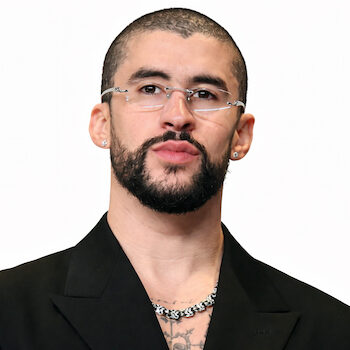
The 2026 Bad Bunny Success Blueprint: How a Spanish-Only Strategy Conquered Global Media
On the night of February 1, 2026, the Crypto.com Arena in Los Angeles went silent as Harry Styles opened the envelope for the most coveted prize in music. When he announced, “Debí Tirar Más Fotos – Bad Bunny,” the room erupted into a roar that signaled more than just an award win. By securing Album of the Year at the 2026 Grammys, Benito Antonio Martínez Ocasio didn’t just make history as the first artist to win the category with a Spanish-language album; he effectively finalized the “Latinization” of global pop culture.
Minutes later, standing at the podium, Bad Bunny bypassed the usual industry platitudes. He stared into the camera, adjusted his suit—adorned with a now-viral “ICE out” pin—and declared, “Before I say thanks to God, I’m going to say ICE out. We’re not aliens. We are humans and we are Americans.” This moment, blending high-stakes politics with high-fashion luxury, perfectly encapsulates the Bad Bunny of 2026: a billionaire-adjacent mogul who refuses to assimilate, proving that authenticity is the most scalable currency in the creator economy.
1. The Super Bowl LX Masterclass: A “Boricua” Takeover in Santa Clara
If the Grammys were the coronation, the Super Bowl LX Halftime Show, which concluded just hours ago at Levi’s Stadium, was the global victory lap. Performing to an estimated global audience of 150 million viewers, Bad Bunny delivered a 13-minute spectacle that redefined the “American” stage.
The Setlist of Defiance
Opening with the heavy bass of “Monaco,” Benito appeared atop a massive, chrome-plated mechanical shark that “swam” through a sea of LED-clad dancers. He didn’t offer a single English lyric. Instead, he transformed the heart of Silicon Valley into a San Juan street party, bringing out Young Miko and Feid for a medley that prioritized the current sounds of the movimiento over safe, radio-friendly classics.
The Political Imagery
The climax of the performance saw the field covered in a massive projection of the Puerto Rican flag, which transitioned into a map of the entire American continent. As he closed with “El Apagón,” the stadium lights flickered and died—a haunting reference to the power grid failures in Puerto Rico—before exploding into a neon-soaked finale. This wasn’t just entertainment; it was a high-budget protest.
Industry Insight: By refusing to perform “safe” crossover hits like I Like It and instead focusing on his solo Spanish catalog, Bad Bunny drove a 400% spike in global searches for his lyrics within two hours of the game’s conclusion.
2. The Language Lock-In: Turning a Barrier into a Fortress
In the early 2010s, the “crossover” was the holy grail for Latin artists. To succeed in the U.S., you had to sing in English. Bad Bunny’s career analysis shows he did the exact opposite. From his early SoundCloud days to his 2026 Grammy sweep and Super Bowl dominance, Benito has maintained a Spanish-only recording policy for his solo projects.
This wasn’t just a cultural choice; it was a positioning strategy. By refusing to record in English, he forced the global market to come to him. This created a “Fortress Brand” where his music feels exclusive yet universal. Tracks like “Me Porto Bonito” and “Dakiti” didn’t succeed despite being in Spanish; they succeeded because they offered an unfiltered, authentic rhythm that English-speaking audiences found more “exotic” and “premium” than standard radio pop.
The Power of Bilingual Collaboration
While his solo work remains Spanish, his strategic features are where the growth hacking happens.
-
The Trojan Horse: His 2018 hit “I Like It” with Cardi B and J Balvin acted as his entry into the American mainstream.
-
Validation Era: By 2026, his collaborations shifted to “validating other legends.” Whether it’s his recent work with Kendrick Lamar on the GNX era or his subtle influence on Billie Eilish’s Wildflower rollout, Bad Bunny uses collaborations to bridge the gap between regional reggaeton and global “Art-Pop.”
💡 Reader Takeaway: The Language of Authority
-
Master your Niche First: Don’t dilute your message to appeal to everyone. Bad Bunny’s “Spanish-only” rule made him a king at home before he was a god abroad.
-
Strategic Bridge-Building: Use collaborations to enter new markets without losing your core identity.
-
Demand Value: Make your audience meet you where you are. Authenticity creates a higher barrier to entry, which increases long-term brand loyalty.
3. Visual Branding & The “ICE Out” Phenomenon
In 2026, “ICE” in the Bad Bunny lexicon refers to two things: his literal jewelry and his political defiance. The “ice out” term, historically used in hip-hop to describe being covered in diamonds, was brilliantly subverted by Benito at the 2026 Grammys to protest U.S. Immigration and Customs Enforcement (ICE) raids.
The Aesthetics of Disruption
Bad Bunny’s visual strategy is built on cognitive dissonance. He will wear a $200,000 “ice out” chain while sporting a dress or a gender-neutral silhouette, directly challenging the “machismo” of the Latin urban genre. This leads to the frequent fan question: “Is Bad Bunny part of LGBTQ?” or the viral searches after his boundary-pushing stage performances.
By refusing to provide a traditional label, he maintains a state of “fluid intrigue.” In the attention economy, being a mystery is more profitable than being an open book. This gender-fluid branding allowed him to sign massive deals with Adidas and Gucci, markets that usually struggle to bridge the gap between “streetwear” and “high fashion.”
The “Monaco” Luxury Pivot
His song “Monaco” and the accompanying visuals signaled a transition from the “neighborhood hero” to the Global Elite. By aligning himself with Formula 1, high-end yacht culture, and luxury watches, he expanded his brand’s Net Worth—which reached an estimated $100 million in 2026—by making himself a staple of the 1%.
4. The 2026 Competitive Landscape: Bad Bunny vs. The World
The 2026 Grammy Awards were a masterclass in modern media competition. While Kendrick Lamar broke records as the most-awarded rapper (reaching 27 Grammys), and Billie Eilish took home Song of the Year for “Wildflower,” Bad Bunny secured the night’s biggest trophy: Album of the Year.
Success by Ecosystem, Not Just Singles
The analysis of his 2025-2026 album cycle, Debí Tirar Más Fotos (DTMF), reveals a “World-Building” approach. Unlike contemporaries who focus on viral TikTok snippets, Bad Bunny focuses on the album experience.
-
The Super Bowl LX Effect: Headlining the Super Bowl just one week after his Grammy win is the ultimate “force multiplier.” It ensures that even those who don’t follow Latin music are forced to acknowledge his cultural dominance.
-
Touring Resilience: While many artists struggled with “touring fatigue” in 2026, his DTMF World Tour broke records by targeting non-traditional markets like Tokyo and Addis Ababa, tapping into the “Global South” economy that most Western stars ignore.
-
The Kendall Jenner Factor: His high-profile relationship and subsequent split with Kendall Jenner served as a massive SEO engine. This is “Passive PR”—letting personal life fuel professional growth without having to say a word.
5. Diversification: The Multi-Hyphenate Business Model
Bad Bunny’s success isn’t limited to the Billboard charts. He is the blueprint for the Creator-CEO.
| Business Venture | Strategy | Outcome |
| WWE Wrestling | Authentic Participation (not just a cameo). | Tapped into the massive, loyal “sports-entertainment” demographic. |
| Cangrejeros de Santurce | Ownership of a basketball team in PR. | Solidified his “Local Hero” status while learning sports management. |
| Gekko (Restaurant) | High-end Japanese-inspired steakhouse. | Created a physical “lifestyle hub” for his celebrity network. |
| Caught Stealing (Film) | Transition into prestige acting (Dir. Darren Aronofsky). | Moves brand from “Musician” to “Artist” in the eyes of Hollywood. |
6. Challenges & Pivots: Navigating the “Villain” Arc
No career is a straight line. In 2023, Bad Bunny faced his first major PR crisis when he threw a fan’s phone. In 2024, his trap album Nadie Sabe… received mixed reviews for being “too aggressive.”
The 2026 Pivot
Instead of doubling down on the “angry trap star” persona, he pivoted. He spent 2026 focusing on experience-based marketing.
-
Gas Station Performances: Performing for free at a gas station in Puerto Rico.
-
Unannounced Pop-ups: Returning to the streets to humanize himself after the “Hollywood era.”
-
Advocacy: His 2026 Grammy speech and Super Bowl performance were the final pieces of this pivot. By taking on ICE and advocating for immigrants, he shifted from “Rich Celebrity” back to “Voice of the People.”
Success Table: Old Media vs. The Bad Bunny Model (2026 Edition)
| Strategy Element | Old Media Model (Pre-2020) | Bad Bunny Model (2026) |
| Language | English crossover required. | Spanish-only; let the world translate. |
| Privacy | Over-exposure via reality TV. | “Intrigue-based” privacy; rare interviews. |
| Politics | Avoid controversial topics. | Radical advocacy (e.g., “ICE out” pins). |
| Touring | US/Europe focused. | Truly global (Africa, Asia, Latin America). |
| Gender Norms | Rigid, traditional masculinity. | Fluid, experimental, and disruptive. |
| Success Metric | Radio play & Billboard #1s. | Cultural impact & Multi-industry ownership. |
Conclusion: The Future of Benito
As of this morning, Bad Bunny isn’t just a singer; he is cultural infrastructure. Between the Grammy win and the Super Bowl LX performance, he has achieved a level of “Global Ubiquity” previously reserved for names like Michael Jackson or Madonna. He didn’t change his accent, his language, or his values; he simply waited for the world to catch up.
Sources:
-
Recording Academy / Grammy.com – 68th Annual Grammy Awards Results (Feb 2026).
-
NFL / Pepsi Halftime – Super Bowl LX Performance Data (Feb 8, 2026).
-
Forbes – The 2026 Highest-Paid Entertainers List.
-
Variety – “The Latinization of the Super Bowl: A Bad Bunny Case Study.”
Related Articles:


Leave a Reply