
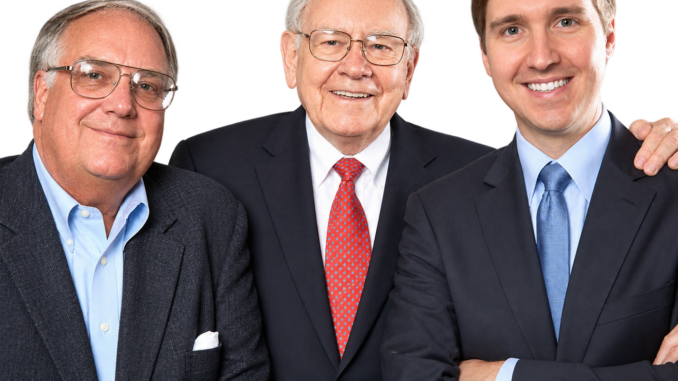
Warren Buffett Steps Aside at 96: Son Howard Takes the Chairman’s Seat at Berkshire Hathaway
Warren Buffett’s long reign over Berkshire Hathaway has ended—but his influence has not. On September 18, 2026, the 96-year-old investor stepped down as chairman, became chairman emeritus, and handed the board’s top role to his son, Howard G. Buffett.
The move marks one of the most important leadership changes in modern business. It also answers a question Berkshire shareholders have asked for years: how can the company preserve Warren Buffett’s culture after Warren Buffett?
The answer is a carefully divided succession plan.
Greg Abel runs Berkshire Hathaway as chief executive officer. Howard Buffett now serves as chairman, with a narrower but highly symbolic mission: protect the company’s values, reputation, and long-term mindset.
Is Howard Buffett Warren Buffett’s son?
Yes. Howard Graham Buffett is Warren Buffett’s eldest son and middle child. He was born on December 16, 1954, and grew up in Omaha with his sister, Susan, and younger brother, Peter.
Howard has served on Berkshire Hathaway’s board since 1993. That 33-year apprenticeship gave him a deep understanding of the company before he became chairman. Warren Buffett described the arrangement in unusually clear terms:
“Greg runs the company; Howard will guard its culture and values.”
Warren also called Howard a “policy the shareholders own and hope never to claim against.” In plain language, Howard is not expected to manage Berkshire’s daily operations. His job is to help ensure that the company does not drift too far from the principles that built it.
Who is Berkshire Hathaway’s CEO?
Greg Abel is the current CEO of Berkshire Hathaway. He took over the chief executive role on January 1, 2026, after Warren Buffett retired as CEO at the end of 2025.
Abel has spent decades inside the Berkshire system. Before becoming CEO, he led Berkshire Hathaway Energy and became known for operational discipline and a strong understanding of the company’s decentralized structure.
The leadership roles now look like this:
This division is important because Berkshire is not a typical corporation. Its dozens of businesses operate with considerable freedom. Managers are expected to act like owners, avoid needless bureaucracy, and think in decades rather than quarters.
Why did Warren Buffett step down?
The immediate reason is age and timing. Warren Buffett turned 96 in August 2026 and has spent more than 60 years leading Berkshire Hathaway. The company said the transition followed its long-standing succession plan.
But Buffett’s own explanation was less about retirement than confidence.
In his shareholder letter, he said Greg Abel had exceeded his expectations and had already been making the decisions that mattered. Buffett wrote that he had “not had to think twice” about Abel’s leadership.
That confidence helps explain why Buffett did not simply leave Berkshire altogether. He will remain on the board as chairman emeritus and continue offering his judgment.
So, is Warren Buffett fully retired? Not quite.
He has stepped down from Berkshire’s top leadership posts, but he remains connected to the company he has shaped since 1965. The change is better understood as a transfer of daily authority, not a complete disappearance.
Howard Buffett is more farmer than investor
Howard Buffett did not follow his father into a career built around stock picking. His path has been unusually varied.
He has worked as a:
-
Farmer.
-
Photographer.
-
Conservationist.
-
Business executive.
-
Former county sheriff.
-
Humanitarian.
-
Philanthropist.
Howard began farming in Nebraska in 1977. He later moved into Illinois agriculture and continues to oversee a large family farm. Reports describe him as managing about 1,500 acres in Illinois, along with additional farmland in Nebraska and research farms connected to his foundation.
Does Howard Buffett still farm? Yes. Farming remains a central part of his life and public identity.
That detail matters because it separates Howard from the usual image of a billionaire heir. He is not known for living only in boardrooms or private investment offices. His work has often placed him close to soil, food production, rural communities, and humanitarian crises.
His experience also gives him a practical connection to Berkshire’s culture. Berkshire values patience, careful stewardship, and long-term thinking. Farming demands all three.
Howard Buffett’s family and personal life
Howard Buffett has been married more than once. Public reports identify his current wife as Devon Goss, following an earlier marriage to Marcia Duncan. He has a son, Howard Warren Buffett, who has worked in political and policy-related fields.
Searches for “Howard W. Buffett children” often cause confusion because the names overlap across generations. Howard G. Buffett is Warren Buffett’s son. Howard Warren Buffett is Howard G. Buffett’s son—and Warren Buffett’s grandson.
The Buffett family includes several grandchildren and great-grandchildren. Warren has generally kept family life more private than his public business career, though he has spoken warmly about spending time with younger generations.
One name that sometimes appears in searches is Lili Thomas Buffett. She is associated with the wider Buffett family, but public information about private family relationships can be incomplete or inconsistent. It is best not to treat every online family-tree claim as verified.
Howard Buffett’s net worth
Howard Buffett’s personal wealth is difficult to calculate with precision.
Some celebrity-finance websites have estimated his net worth at roughly $4 million, but such figures are not audited and should be treated cautiously.
That estimate may surprise people who know he is Warren Buffett’s son. But Howard has long been associated with a different approach to wealth and inheritance. Warren Buffett has repeatedly said that his children would receive enough to do anything—but not enough to do nothing.
Howard’s public work also centers less on personal luxury than on agriculture, conservation, food security, and humanitarian aid. His life illustrates an important distinction: being born into a famous family does not require following the family business in the same way.
The Howard G. Buffett Foundation
Howard has led the Howard G. Buffett Foundation since 1999. The foundation focuses on problems that are often overlooked until they become emergencies.
Its work includes:
-
Global food security.
-
Conflict mitigation.
-
Public safety.
-
Conservation.
-
Human trafficking prevention.
-
Support for communities affected by war and instability.
The foundation has committed billions of dollars to humanitarian and development projects, according to public profiles of its work.
Howard also served for nearly a decade as a United Nations World Food Programme goodwill ambassador against hunger. His photography has taken him into farming regions and conflict zones, where he documented the human cost of food shortages and violence.
This is one reason Howard Buffett matters beyond Berkshire Hathaway. His public identity is not only “Warren Buffett’s son.” He has built a separate record in agriculture and humanitarian service.
Warren Buffett on tariffs and Donald Trump
Warren Buffett has often warned that tariffs can act like a tax on consumers. When the United States imposes tariffs on imported goods, businesses may pass higher costs to customers, absorb lower profits, or search for new suppliers.
Buffett has also criticized trade conflict because it can damage cooperation between countries. His broader view has usually favored open trade and economic relationships that allow countries to specialize and exchange goods.
That does not mean Buffett supported every trade policy or every administration. His comments on tariffs have generally focused on economic consequences rather than partisan politics.
The same principle appears in Berkshire’s investing style: avoid emotional decisions, understand the underlying economics, and think about second-order effects.
Warren Buffett, war, and public responsibility
Buffett has not been a traditional foreign-policy commentator, but his businesses and philanthropic interests have brought him close to issues involving war, poverty, food insecurity, and displaced populations.
Howard Buffett, in particular, has worked in places affected by conflict. His foundation’s focus on food security and conflict mitigation reflects a belief that hunger is not only a humanitarian issue. It can also contribute to instability and violence.
That work gives the Buffett name a meaning beyond stock-market returns. Berkshire Hathaway is known for buying businesses. Howard’s foundation is known for helping communities survive crises.
Both efforts reflect a similar idea: resources matter most when they are managed carefully and directed toward durable results.
Warren Buffett’s biggest warning for retirement
Warren Buffett’s most consistent warning to people approaching retirement is not to let fear control their money.
Market declines can feel especially dangerous when someone is no longer earning a salary. But selling investments in panic can turn a temporary decline into a permanent loss. Buffett has also warned against high fees, complicated products, excessive debt, and investments that the buyer does not understand.
His retirement message can be reduced to several practical principles:
-
Keep investment costs low.
-
Avoid high-interest debt and excessive leverage.
-
Maintain enough cash for genuine needs.
-
Do not make major decisions based on headlines.
-
Diversify if you cannot evaluate individual businesses.
-
Stay invested according to a long-term plan.
-
Ignore confident predictions about the next market move.
For many people, a low-cost index fund may be more appropriate than trying to copy Berkshire Hathaway’s concentrated stock portfolio. Buffett has often said that most investors are better served by a simple, low-cost approach than by expensive advice or frequent trading.
The deeper lesson is emotional discipline. Retirement planning is not only about choosing investments. It is about building a plan you can follow when markets are frightening.
What today’s stock-market news means
The news that Warren Buffett stepped down as Berkshire Hathaway chairman is significant, but it does not automatically change the value of Berkshire’s businesses or determine what investors should do with BRK.A or BRK.B shares.
Berkshire remains a large, diversified company with operations in:
-
Insurance and reinsurance.
-
Freight railroads.
-
Utilities and energy.
-
Manufacturing.
-
Retail and services.
-
Public-company investments.
The company’s 2025 annual letter said Berkshire generated $44.5 billion in operating earnings and held more than $370 billion in cash and U.S. Treasury holdings at year-end.
Those figures show why shareholders pay attention to leadership changes. Berkshire has enormous financial resources, and decisions about capital allocation can affect investors, employees, customers, and entire industries.
Still, the succession announcement was designed to reduce uncertainty:
-
Greg Abel controls operations.
-
Howard Buffett protects culture.
-
Warren Buffett remains available as a director and adviser.
For investors following stock market news today, the most useful question is not whether Warren Buffett is completely gone. It is whether Berkshire’s discipline survives without him making every major call.
Why Warren Buffett matters beyond Wall Street
Warren Buffett became famous for turning ordinary businesses, patient investing, and plainspoken letters into a global financial education.
But his importance extends beyond market performance.
He showed that business leadership could be:
-
Patient instead of frantic.
-
Honest about mistakes.
-
Focused on owners rather than short-term speculation.
-
Simple enough for ordinary people to understand.
-
Connected to personal character.
His annual shareholder letters helped generations of readers understand compounding, incentives, risk, reputation, and human behavior. His famous advice—“Be fearful when others are greedy, and greedy when others are fearful”—became popular because it speaks to a problem deeper than investing: the difficulty of staying calm when everyone else is reacting.
The next phase of Berkshire Hathaway will test whether those ideas belong to Warren Buffett alone or whether they have become part of the institution.
Howard Buffett’s appointment suggests Berkshire wants the answer to be the latter.
Warren Buffett built the machine. Greg Abel now runs it. Howard Buffett has been asked to help ensure it still has a soul.
Sources
-
Berkshire Hathaway Inc. news release and Warren Buffett’s September 18, 2026 shareholder letter.
-
Berkshire Hathaway 2025 annual letter, including Greg Abel’s leadership framework and company financial information.
-
CNN report on Warren Buffett becoming chairman emeritus and Howard Buffett becoming chairman.
-
The Guardian report on Berkshire Hathaway’s leadership transition.
-
Business Insider profile of Howard Buffett’s farming, corporate, and philanthropic work.
-
Infobae profile covering Howard Buffett’s family, farming, and foundation work.
-
Associated Press summary of Warren Buffett’s investing advice.


Leave a Reply